Tuesday, July 5, 2022

For the love of grading

A new assignment gave me new grading life! Instead of a final paper, I gave students the option of creating a podcast episode or vlog on a topic of their choosing related to tourism, travel, and hospitality as an industry.

I had fun grading and even found that I began to just listen to the projects as an interested listener as opposed to a rubric-minded red-pen-handed teacher.

Art with graded paper and school supplies and says For the Love of Grading

With ample opportunities to practice their writing already, I made space for another creative vehicle they could use to showcase their understanding and learning. The assignment still met our learning objectives; it required research, critically analyzing a topic, organizing the material for an audience, and presenting.

The podcast/vlog assignment infused our class with a creative outlet and encouraged students to find/learn/use technology as a tool. They had to really think about their audience and universal design/accessibility in their content creation (adding captions). 

Students really got into the project. Some created b-roll for their backgrounds and others created show graphics for their new podcast. A few said how much fun they had and discovered a passion for podcasting. One said she might even keep adding episodes to her show. Students can add this project to electronic portfolios and share their work more broadly. Here are the details I gave them. Feel free to adapt it to your needs.

Assignment Details

You will take one aspect of the TTH industry you’d like to investigate further. Or you can present a sales presentation on a property or destination. Or you can interview someone working in the TTH industry.

You will present your findings and discoveries as a podcast or vlog (video blog) of 5-8 minutes, complete with script so it can be universal design and captioned. This should be your own original work and can be included in your e-portfolio. And if it's a show-stopper, we could place it on the department's YouTube or Comm Speaks podcast (with your permission - and permission of any of your guests).

Industry-specific podcasts for ideas and inspiration: https://www.allintheindustry.com/ or https://www.slicktalkthepodcast.com/podcast 

Here's a list of 15 best travel podcasts: https://discoverpods.com/travel-podcasts/ 

Ideas (you can use one of these or come up with something that interests you):

  • Investigate further a type of tourism
  • Dive into one of the Elizabeth Becker's destinations and give a "where are they now" update
  • Analyze your own town's tourism efforts
  • Take a topic from our OER and see how another country compares to Canada
  • How to be a responsible tourist
  • The future of a piece of the travel/tourism industry
  • Interview someone who works in the industry

You can use free podcasting tools or in Canvas, head to Studio. You can make a vlog with screen-in-screen, or you can tell it audio-only. Consume a few vlogs or podcasts to get a feel for the medium. Work from a script or at least an outline of what you want to talk about. If you don't, you might wander and your listener will get lost. Practicing just a little will help you estimate your time. 5-8 mins. flies once you get going.

Here are some great tips about planning an episode of a podcast (or vlog): https://improvepodcast.com/9-key-tips-on-how-to-plan-podcast-episodes/

  • Introduce yourself and your topic to your audience.
  • Talk about your topic and what you want to share with the listener.
  • Orally cite sources like ... "the number of tourists increased 10 fold according to an article in The New York Times." 
  • Make your points.
  • Use conversational language.
  • Have an exit strategy. You don't want the awkward "um, bye" (that I do on my weekly welcome videos!) Thank your listeners and if you have a regular show, invite them to the next one. 

Topics to Avoid - please steer away from these kinds of ideas because I want you to take a larger, industry look.
-My Trip to ____________
-Top X things to do in _________

TURN IN: You'll turn in both the vlog/podcast (upload or a link) and your script that could be used to caption it.

Sunday, May 1, 2022

When students need a break

Reading your audience is something we teach in communication courses. As teachers, we are constantly scanning for understanding and confusion on faces or Zoom screens — gauging our audience. So when a more vocal student tells you that students are tired and you see an entire class or screen of nodding heads, you listen.

This happened in a recent graduate seminar. At about the 10-week mark, students were stressing beyond their normal stress. A student messaged me that they needed a break. So, during class I asked them how the semester was going and they said they were exhausted. I felt it, too. The ongoing pandemic and a drama-filled semester can do that. 

Says: It's time for a break

I thought about just canceling a class meeting to give them time for self-care or whatever they most needed. Instead, I offered them brief one-on-one consultations over a two-week period. They could use that time to chat about their final project, vent, or just pick my brain. They selected their time to Zoom in on a Google Doc. They received individualized instruction and got some time back to handle however they most needed. It was wonderful to have focused time with each one of them and get a truer sense for what they needed related to our class, our program, and their career path. 

Sometimes, we just need a switch-up, something different for a class. Maybe it's a break or maybe it's one of these ideas:

  • One-on-one consultations--This works well for courses with a large project or with seniors or graduate students who may also be seeking career and program advice.
  • Guest speakers--Sometimes, the constant that needs to change is us. A new voice, even if it's saying the same words we say, can resonate. Or have students step into the role of the professor. My daughter's kindergarten teacher used this tactic and it made my little feel so important. 
  • Change your modality/location--With so many schools set up for an easy pivot (you're tired of this word, I know), you could meet online for a class. Make a quick trip to the library for APA review. Or did you ever have a teacher who would take you outside? I loved that. I have designs on an evening sunset meeting at our Fort Worth campus where grad students bring lawn chairs and we have a "campfire" class. It's such a beautiful view on the prairie and lends itself to a philosophical chat about communication ethics.
  • Change your format--Do you normally use a lecture method? Switch to a facilitator model or open discussion format. One evening I simply ditched my PowerPoint and started a discussion. Our grad students found the change of pace refreshing.

What do you do when you or your students just need a break?

<<Written in a past semester>>

Tuesday, April 19, 2022

Educational Excellence Week - Notes and Takeaways

I love a presentation with takeaways I can implement immediately. If your campus has an Educational Excellence Week, your fellow teachers will load you up with their favorite tips and tricks to improve your teaching right now.  Scott January, an instructional designer at Tarleton, had me taking all kinds of notes this morning at our EEWeek in his presentation for making courses more accessible.

A computer with a refreshable braille display.
Photo by Elizabeth Woolner on Unsplash
  • Use Headers in blocks of text. This helps those using a screen reader to jump from header to header. In Canvas, you can find the set headers under the Paragraph section. In Word, you're looking for the headings in the Styles gallery.
  • Customized hyperlinks prevent a screen reader from having to announce a horrible list of characters and letters. Just highlight the words in a sentence you want linked to and engage the link system in Canvas or Word. See the last bullet for an example. And it makes the page look cleaner for everyone.
  • Accessibility Checkers: Canvas has an automatic ADA checker; it looks like a circle with a body inside. Word has one, too! Look under the Review Tab.
  • In Word and Canvas, use the list function to create lists so a screen reader will acknowledge the list.
  • Alternative Text or alt tags are easy and make a huge difference for someone listening to a screen reader. It's basically an embedded description of a visual. Did you know Word lets you add alt tags?
Scott called it "Digital Equity" and using Universal Design can help all learners. 

Monday, April 4, 2022

Panel Power!


Four women at a conference

The 2022 Texas Women in Higher Education conference was a great event! I was especially proud to present on mentoring with Dr. Therese Pennell, Skyla Claxton, and Dr. Rochelle Gregory. Don't you just love it when a plan comes together?! You never know if a panel will gel and this one did. 

Our participants really open up and shared their challenges and mentoring successes. It was as good as you could hope for -- when time is up and no one wants to run to the luncheon immediately. 

In the "it's a small world" category, we discovered that each of us had Tarleton State connections. Dr. Pennell and I know each other and teach in the same college. Skyla and Dr. Gregory have Tarleton master's degrees.

After two years of virtual-only attendance, I found the renewal and networking of a face-to-face conference to be exactly what I needed for the end-of-the-semester slide.

Until next year, TWHE! See you in Denton.

Thursday, January 13, 2022

Resource Share - AHB's Manuscript Recipe

Dr. Amber Harris Bozer avatar

One of my colleagues has launched a website full of resources that can help us all. Dr. Amber Harris Bozer is one cool cat. I love this neuroscientist's passion for sharing and learning! As Associate Editor for the Journal of Social Media in Society, she created an entire how-to manual for our editorial team. And now, she's creating and curating how-to's for researchers at all stages.

Dr. Harris Bozer's ability to organize and outline processes is one to emulate. On her website, she has a Manuscript Recipe that might help you as you revamp an article or strike out on your first one, step by step. You'll also find a timeline for thesis/dissertation committees that will guide chairs and students alike. She has it all for you to download, adapt, and share some more. 

Monday, December 13, 2021

Commencement 2021 - New MAs


6 people in graduation regalia

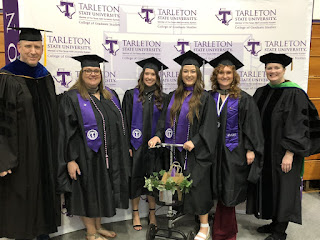
Don't you just love Commencement!?! It's such a happy time and one of such pride. Pictured here are our master's students who graduated this semester and my colleague Dr. Paul Stafford. Comprehensive exams were bad enough in a regular year, but can you imagine tackling graduate school hoops during a pandemic? These grads have such bright futures and that's what commencement is about for me -- the next step and more possibilities, from pursing doctorates to launching new businesses to new discovering locations! Onward, Texans! 💜

Wednesday, September 29, 2021

Free Article: Stakeholder Expectations for Social Media Listening

Dr. Chris Gearhart and I merged our research interests to tackle what stakeholders expect in listening (and responding) in social media dialog. We found that higher active-empathic responses were rated as more competent and offer some ideas for social media managers. 

Here's a link to free copies of our research. Enjoy!

https://www.tandfonline.com/eprint/PMVI4NAQXJRYRICJH8GK/full?target=10.1080/10904018.2019.1602046

Gearhart, C. C., & Maben, S. K. (2021). Active and empathic listening in social media: What do stakeholders really expect. International Journal of Listening, 35(3), 166-187. DOI: 10.1080/10904018.2019.1602046