Tuesday, April 19, 2022

Educational Excellence Week - Notes and Takeaways

I love a presentation with takeaways I can implement immediately. If your campus has an Educational Excellence Week, your fellow teachers will load you up with their favorite tips and tricks to improve your teaching right now.  Scott January, an instructional designer at Tarleton, had me taking all kinds of notes this morning at our EEWeek in his presentation for making courses more accessible.

A computer with a refreshable braille display.
Photo by Elizabeth Woolner on Unsplash
  • Use Headers in blocks of text. This helps those using a screen reader to jump from header to header. In Canvas, you can find the set headers under the Paragraph section. In Word, you're looking for the headings in the Styles gallery.
  • Customized hyperlinks prevent a screen reader from having to announce a horrible list of characters and letters. Just highlight the words in a sentence you want linked to and engage the link system in Canvas or Word. See the last bullet for an example. And it makes the page look cleaner for everyone.
  • Accessibility Checkers: Canvas has an automatic ADA checker; it looks like a circle with a body inside. Word has one, too! Look under the Review Tab.
  • In Word and Canvas, use the list function to create lists so a screen reader will acknowledge the list.
  • Alternative Text or alt tags are easy and make a huge difference for someone listening to a screen reader. It's basically an embedded description of a visual. Did you know Word lets you add alt tags?
Scott called it "Digital Equity" and using Universal Design can help all learners. 

Monday, April 4, 2022

Panel Power!


Four women at a conference

The 2022 Texas Women in Higher Education conference was a great event! I was especially proud to present on mentoring with Dr. Therese Pennell, Skyla Claxton, and Dr. Rochelle Gregory. Don't you just love it when a plan comes together?! You never know if a panel will gel and this one did. 

Our participants really open up and shared their challenges and mentoring successes. It was as good as you could hope for -- when time is up and no one wants to run to the luncheon immediately. 

In the "it's a small world" category, we discovered that each of us had Tarleton State connections. Dr. Pennell and I know each other and teach in the same college. Skyla and Dr. Gregory have Tarleton master's degrees.

After two years of virtual-only attendance, I found the renewal and networking of a face-to-face conference to be exactly what I needed for the end-of-the-semester slide.

Until next year, TWHE! See you in Denton.

Thursday, January 13, 2022

Resource Share - AHB's Manuscript Recipe

Dr. Amber Harris Bozer avatar

One of my colleagues has launched a website full of resources that can help us all. Dr. Amber Harris Bozer is one cool cat. I love this neuroscientist's passion for sharing and learning! As Associate Editor for the Journal of Social Media in Society, she created an entire how-to manual for our editorial team. And now, she's creating and curating how-to's for researchers at all stages.

Dr. Harris Bozer's ability to organize and outline processes is one to emulate. On her website, she has a Manuscript Recipe that might help you as you revamp an article or strike out on your first one, step by step. You'll also find a timeline for thesis/dissertation committees that will guide chairs and students alike. She has it all for you to download, adapt, and share some more. 

Monday, December 13, 2021

Commencement 2021 - New MAs


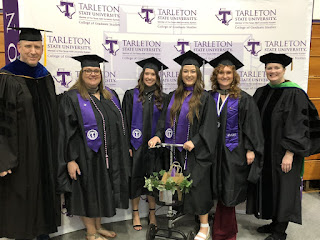
6 people in graduation regalia

Don't you just love Commencement!?! It's such a happy time and one of such pride. Pictured here are our master's students who graduated this semester and my colleague Dr. Paul Stafford. Comprehensive exams were bad enough in a regular year, but can you imagine tackling graduate school hoops during a pandemic? These grads have such bright futures and that's what commencement is about for me -- the next step and more possibilities, from pursing doctorates to launching new businesses to new discovering locations! Onward, Texans! 💜

Wednesday, September 29, 2021

Free Article: Stakeholder Expectations for Social Media Listening

Dr. Chris Gearhart and I merged our research interests to tackle what stakeholders expect in listening (and responding) in social media dialog. We found that higher active-empathic responses were rated as more competent and offer some ideas for social media managers. 

Here's a link to free copies of our research. Enjoy!

https://www.tandfonline.com/eprint/PMVI4NAQXJRYRICJH8GK/full?target=10.1080/10904018.2019.1602046

Gearhart, C. C., & Maben, S. K. (2021). Active and empathic listening in social media: What do stakeholders really expect. International Journal of Listening, 35(3), 166-187. DOI: 10.1080/10904018.2019.1602046

Tuesday, August 10, 2021

Summer of...

When I think of summer progress, I first consider items marked off a to-do list and manuscripts shipped off for publication consideration. But progress is also the things we've learned along the way. 

  • This summer I dove into Nvivo with a friend's help. We are analyzing social media messages from a particular hashtag campaign. Being in the role of the learner is wonderful because we need reminders of what our students feel like when they start a new endeavor in our classes.
  • I jumped into literature about academic mothering and life writing. We are told to find our research areas and not to stray too far, but there is something refreshing about striking out into a new area. 
  • I am reminded about how much I love to write and design. Writing makes me feel like myself and designing gives me a creative outlet. I tend to forget to cultivate these areas in the long semesters. 
  • I tried a new mantra...finish three main to-do list items. For me, it worked. I was able to disconnect at the end of my workday more easily than before.

While it's great to complete grant work and set lofty goals for the next academic year, taking a little time to reflect on what I've learned about myself is valuable as well. 

With only a week left, what are you learning this summer?

Monday, March 15, 2021

Promote Yourself - PR Primer for Academics

News Flash - You are an expert. As an academic, you are an expert within your field. Building your research profile should include some publicity for yourself. It helps you, your department, and your university.

I know, you need one more thing to do. You're already researching and writing, just add a few tasks to the end of each project to-do list.

  1. Write a news release about your research in progress and when you land a publication or present. Send it to your university's media relations team. Even if it doesn't land a big TV news story, placement on the university news page helps your SEO. Need help? Look for a PR writing course on your campus. Students love real-world projects they can include in their portfolios.
  2. Adapt your research into a public-friendly blog post. Send it to your department, center for teaching excellence, research and innovation office, library, and university publicity office with no. 3. The publicity office will LOVE you for helping them do their work. They need content for their magazines, online newsletters, and social media outlets! Our library likes to create displays of faculty research. It's nice when they don't have to hunt down what they need.
  3. Make it visual. Anyone can use Canva.com or a free infographic builder. The hard part of boiling down your work down. 
  4. Take pictures at conferences. Aim for the highest resolution you can, and action shots would be even better. Images and graphics are helpful to your university marketing team when they are trying to put together a publication or a gray web page.
  5. Share your research synopsis and graphic on your own social accounts. If you don't like tooting your own horn, thank your grantor and laud your student-writers and co-authors for their work.
  6. Update your university web page (and all of your academic accounts like ResearchGate, etc.) and add areas of expertise as needed to your web bios.

Now, every university is different. See what is acceptable at yours and ask senior researchers about these ideas and your local points of contact. 

You say, "But, I don't want to look like an arrogant snot." I hear that, but picture this. The university PR team is staring at a list of hundreds of faculty members. They have no idea what everyone is doing. They can't. That's a lot of hunting and individual contacts to build. You can help them by bringing content to them.